Accepted paper · Numerical finance
Deep Learning for European Option Pricing
CEV and stochastic local volatility models
How much flexibility should a pricing model have? We compare five specifications under a common risk-neutral framework and find that a relatively simple CEV structure offers a strong balance of pricing accuracy and stability.
Neural networks extend the volatility structure of CEV and SLV models while retaining their stochastic differential equations. I built the pricing and calibration pipeline using Monte Carlo simulation, truncated Euler discretization, antithetic variance reduction, and two-path unbiased stochastic gradients. The study evaluates pricing errors over time, across option types and maturities, and under repeated random initializations.
Relative pricing error
In the main test, neural CEV records a relative MAE of 32.92%, compared with 41.66% for Black–Scholes, a reduction of approximately 21%. Constant-parameter CEV is very close at 32.99%. The ranking depends on the metric: Black–Scholes has the lowest MSE, while neural SLV has the largest MSE and MAE.
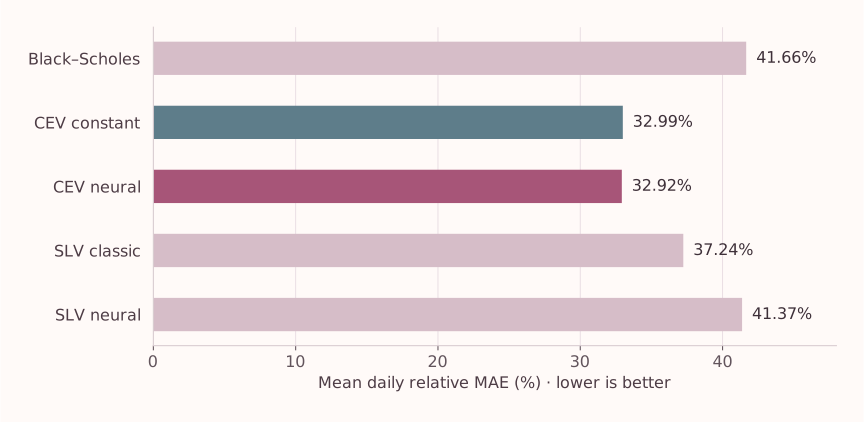
View all pricing metrics
| Model | MSE | MAE | Relative MAE (%) |
|---|---|---|---|
| Black–Scholes | 7855.91 | 50.37 | 41.66 |
| CEV constant | 8516.19 | 49.03 | 32.99 |
| CEV neural | 8532.1 | 49.04 | 32.92 |
| SLV classic | 8253.99 | 49.04 | 37.24 |
| SLV neural | 12433.61 | 60.79 | 41.37 |
Source: author manuscript, Table 1, p. 12. Values retain the manuscript’s rounding.
Stability changes the comparison
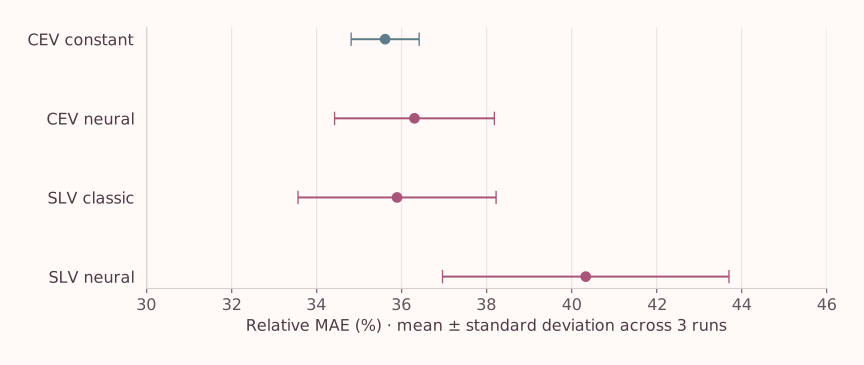
The three-run robustness experiment favors constant-parameter CEV: it has both the lowest average relative error and the smallest standard deviation. Neural CEV’s small lead in the main run does not persist across random seeds. The more flexible neural SLV remains harder to train reliably.
Sample, evaluation & scope
The training period is November 2, 2015–December 12, 2023 (2,113 trading days). The test period is December 13, 2023–December 22, 2025, containing 354,999 option quotes, 9,156 date–underlying–maturity groups, and 529 trading days.
The study compares Black–Scholes, constant-parameter CEV, neural CEV, classical SLV, and neural SLV under common preprocessing and sample splits. The robustness and ablation experiments assess sensitivity to initialization, the SLV base function, and smoothing regularization.
These results concern pricing accuracy in the reported sample. They do not establish hedging performance or tradable returns. The main-run relative-error advantage of neural CEV over constant CEV is small, and neural SLV’s added flexibility does not consistently improve accuracy.
Download main results (CSV) · Download robustness results (CSV)
Source: Cai and Zhang, “Deep Learning for European Option Pricing under CEV and SLV Models,” author manuscript, §4 and Tables 1–3.